Welcome to the final article in this series, links to the other articles are below. This entry is going to focus on the Tight End position and will likely be short.
Scoring Types (Read this please)
Based on feedback, both PPR and Standard graphs will be included and labeled accordingly. For the analysis sections, I will break out PPR and STD if the data tells a different story; if not, I’ll roll the analysis into one bucket.
Final Post in a Series
This is the fourth and final post in a series where I will be diving into RB/WR/TE/QB. The goal is to look at each position independently and try to knit together a cohesive strategy after each position is completed.
- Click me to go to Running Back Performance Article
- Click me to go to Wide Receiver Performance Article
- Click me to go to Quarterback Performance Article
Team Wins
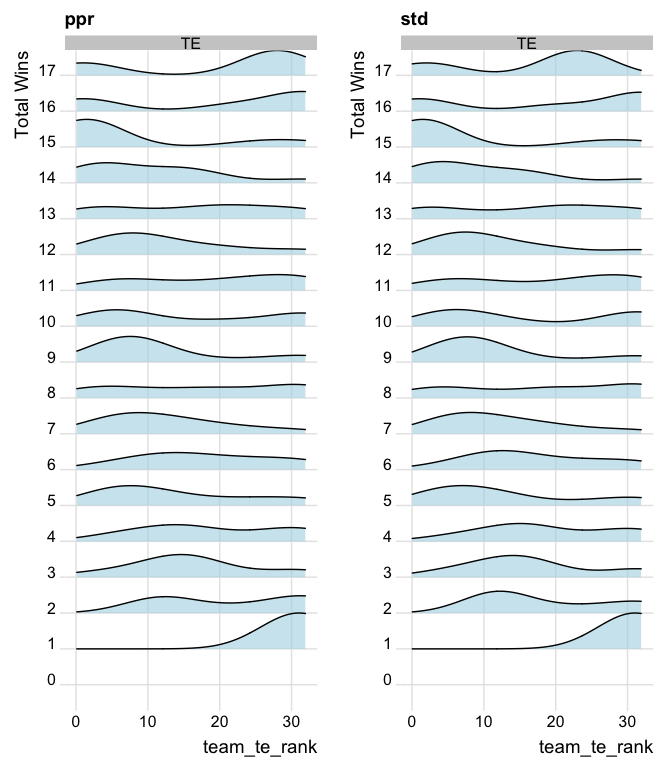
The figure below is showing the density of final tight end rank based on team wins. This is pretty chaotic relative to the other positions (click the links about to see those graphs). It’s likely because the TE position will score fewer points than different positions and therefore is subject to more chaos.
Standard vs. Points per Reception
Nothing stands out to me; the trends generally hold for both scoring methods.
Potential Tight End Tiers
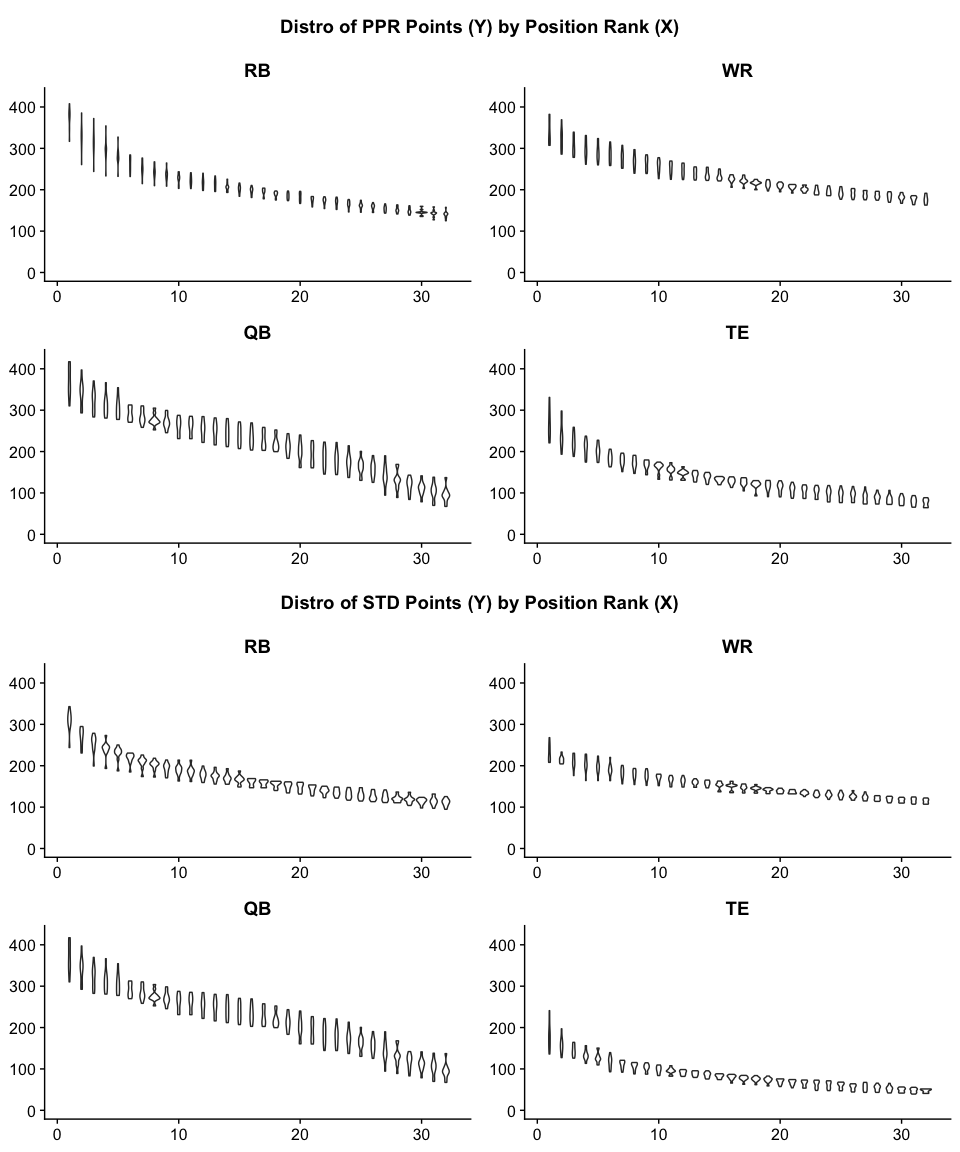
I love tiers, and the tires for the other positions can help shape your draft strategy each year. I think TE will be less ambiguous due to the difference in scoring between the top 3 people, right now it is Kelce, Ertz, Kittle. I believe that is tier 1; everyone else is tier 2.
This analysis is using the graph below this section.
Points Per Reception / Standard Scoring Analysis
- There is a definite advantage when having the top few TEs due to the
steep drop off in points scored after they are taken.
- I also like having a top asset for a midseason trade if needed
- Last year, in a 12 team PPR league, I traded Kelce for Chubb, Golladay and Miller
- I told you this would be short
Point Fluctuations for Top Tight Ends
Let’s focus on weekly fluctuations of points. I find it useful to understand bands of potential scoring so I can evaluate risk.
Yearly Data
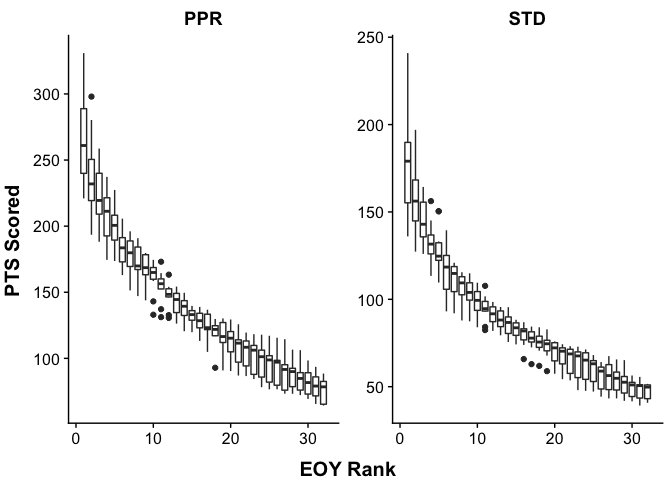
We’ll start by analyzing the scoring bands at the end of the year for the top-ranked players. If you look at the graph below, you’ll notice a steep the drop off in points for both standard and points per reception.
Weekly Changes in Points
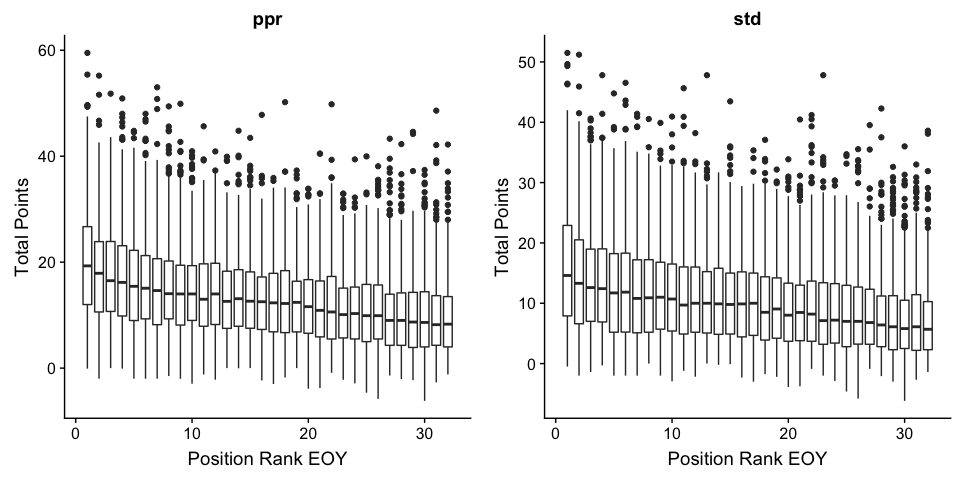
Let’s keep on rolling! Yearly point totals are important; weekly points help you plan for variance in potential outcomes.
Points Per Reception and Standard Scoring Analysis
- The upside for the top TEs in PPR is more significant than standard, which is
expected
- The top TEs have higher targets which lead to higher reception totals
- Keeping with the theme of neglecting TEs, let’s move on!
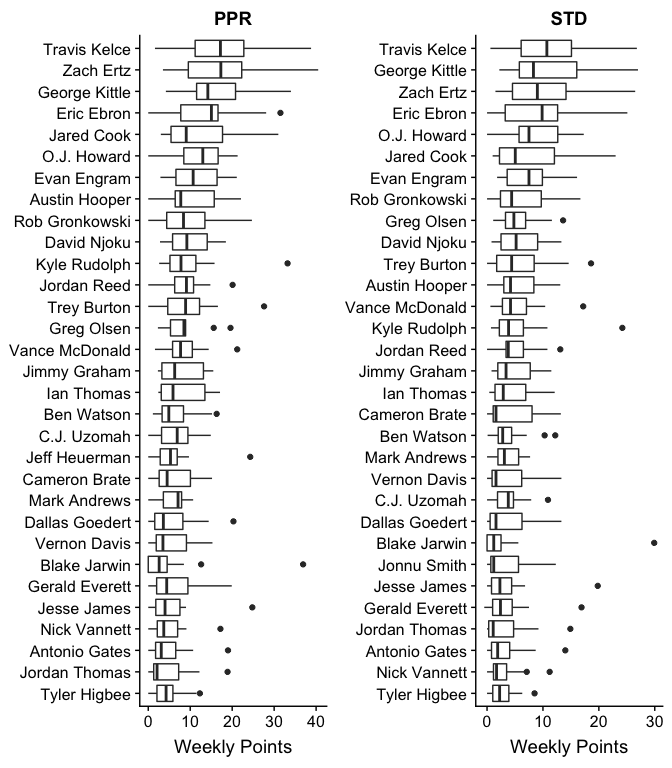
Player Analysis in 2018
This is the first time I’ve ever looked at the TE scores for PPR and Standard lists side by side. I see some exciting variations, relative to what we saw for WR, which were reasonably similar.
Let’s Look at Points Per Reception First
Eric Ebron lived and died by TDs, that is evident in his scoring range.
George Kittle, Zach Ertz, and Travis Kelce are the guys to get next year, if you want a top TE.
David Njoku was disappointing in my eyes; Baker Mayfield had games where he was throwing 40-50 times and Njoku couldn’t capitalize on that volume.
- I do like him going into 2019, especially if Mayfield takes a step forward.
Standard Scoring’s Turn
- Austin Hooper might be a good value if he can get more TDs
- His PPR ranking shows he is getting a lot of receptions, he just needs to convert a one or two more into touchdowns
Combined Conclusion
The tight end position can be a black hole. If that is the only hole, I I wouldn’t worry too much. For 2019, there are high upside guys who might pay dividends, Njoku and Hooper, are two that come to mind. Having Kittle, Ertz or Kelce provide your team with a clear advantage over other teams in your league while also providing trade value if you need to get a guy to fill in for an injured player or address a player underperforming.