Fantasy Performance of Top Wide Receivers
I’ve always wondered what makes a wide receiver elite and what performance I can expect out of them on a weekly basis. Outside skill conversations are their other factors about a player’s situation I should we take into account when it comes to drafting? After looking at running backs in detail, a followup question was asked by some of our readers--at what point is drafting a running back more critical than a wide receiver, and vice versa. In the sister post to this article, we found that there is typically an elite tier of 4-5 running backs each year, and after that opportunity cost of drafting another position starts to make it more enticing to draft a wide receiver. In this article, I'll look at the reverse--when is drafting a wide receiver more essential than a running back?
Scoring Types (Read this please)
Based on feedback, both PPR and Standard graphs are included and labeled accordingly. For the analysis sections, I will break out PPR and STD if the data tells a different story; if not, I’ll roll the analysis into one bucket.
Second in a series
This post is the second post in a series where I will be diving into skill position draft strategies. The goal is to look at each position independently and try to knit together a cohesive strategy after each offensive position is completed.
Running Back Performance Article
Team Wins
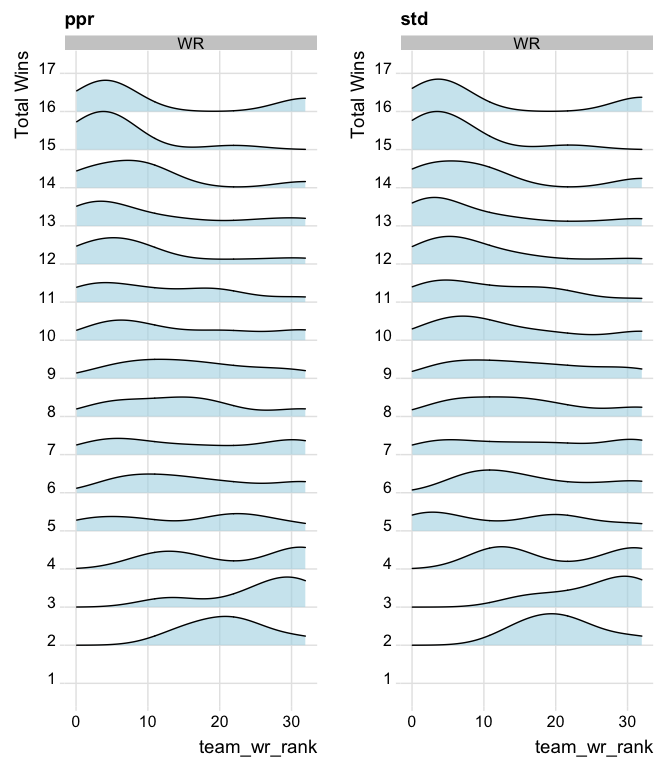
The figure below displays the density of final wide receiver rank against team wins and shows a general trend of higher WR performance on teams with more wins. It is important to note; there aren’t many 17, 16, 15 and 14 win teams so that data might be a little skewed.
Diving into the most current win totals, it’s pretty spread out which doesn’t surprise me. I looked at the impact of QB performance on other positions in this article. The TLDR version, QB quality affects WR performance pretty significantly. It’ll be interesting to see these graphs in our QB post because I expect it will be very correlated.
Standard vs. Points per Reception
Nothing stands out to me; the trends generally hold for both scoring methods.
Potential Wide Receiver Tiers
Tiers are essential to fantasy sports, especially when drafting a team. All the analysis in this section will operate under the assumption we know who will end the season at each rank, which isn't excellent logic when it comes to drafting because you don’t know the exact outcome until after the season. The assumption is the preseason rank = end of season rank (definitely not always the case). This may be more useful for daily fantasy sports where you get to draft based on each player's most updated rank.
As a side note, I'm going to recycle some analysis from the other posts for RB and QB because some of the graphs used in those posts are insightful and apply here as well.
Points Per Reception Scoring Analysis
- The top 2 wide receivers are better than the rest, and then it smooths out until you get to rank 15, and then a second drop occurs.
- It’s interesting because the point totals for players ranked 15-30 don’t seem that different which, makes me think those guys could be interchangeable.
- RB 1-5 are significantly higher than the rest
- The same RB trend applies to QBs
- If you don’t have the top TE, it’s a black hole. What’s interesting here, if you can get a top 10 RB or top 20 WR, it probably doesn’t make sense to reach the top few TEs, assuming your goal is to maximize your team points scored. A top TE gives your team an advantage at that position, but it might cost you an edge at WR or RB. Just to play devil's advocate, an alternate strategy with TE could be to grab the top TE because there always seems to be a guy or two off waivers you can pick up at RB or WR that end up being a top talent. I think the risk of not choosing the right TE or not making the right pickups outweighs the potential benefit, but I can see an argument for the strategy.
Standard Scoring Analysis
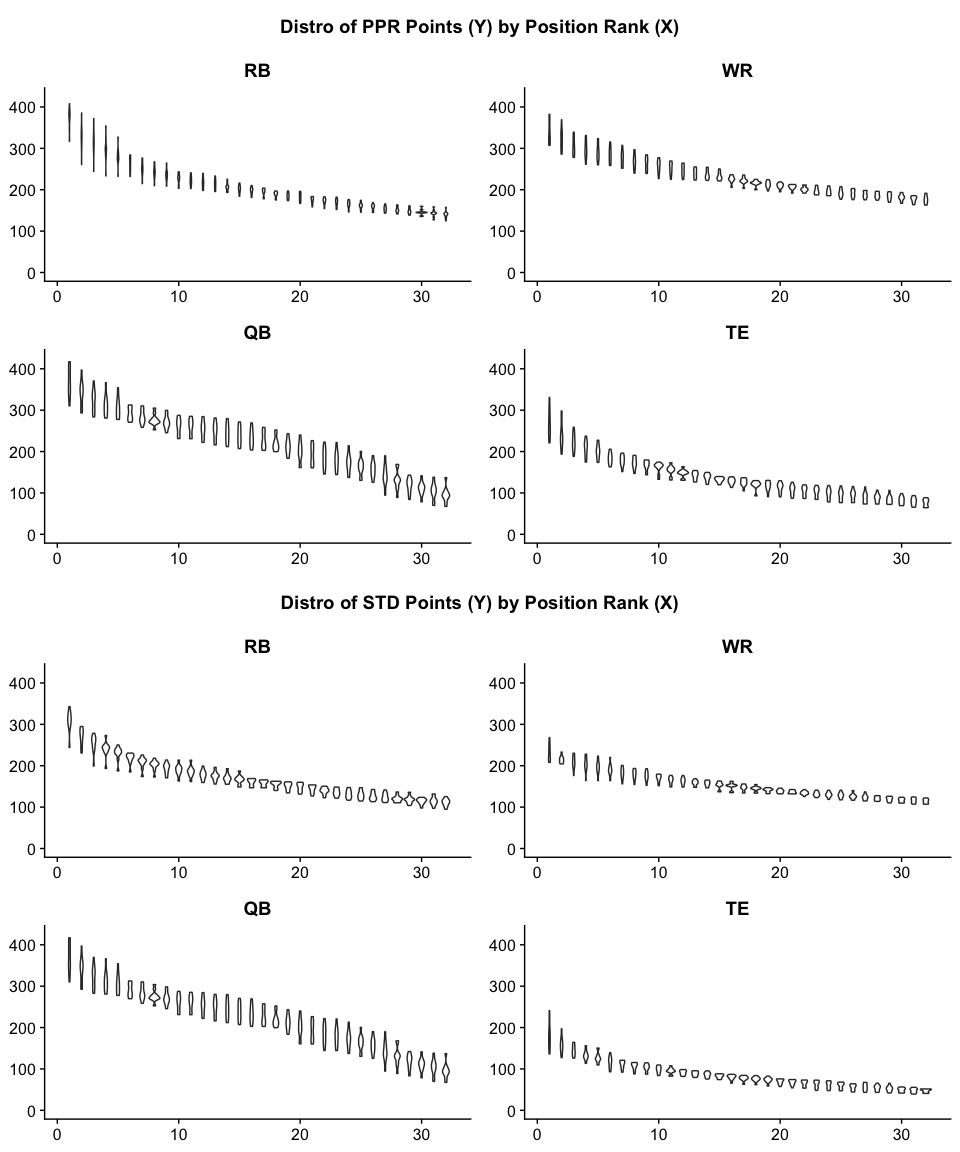
- If you can find the top WR, it seems you have a clear advantage over other teams.
WR Tiers
- The first tier of WR runs from 1-6.
- The second tier of WR runs from 7-9.
After that, I don’t see much separation.
Based on the WR Tiers above, I feel like my general strategy in Standard for the WR position is to get as many top 5-10 projected players.
- After those are gone, I am punting on WR.
RB Tiers
- The top 15 people are clearly above the bottom half.
- This drop is visible right after the 15th person (it’s an exciting drop)
- The point drop off after the first five people which signals a potential to pivot to WR after those players are drafted.
My thoughts on TE don’t change
Now that I’ve seen the data in the graphs above, I will be running the following strategy for my early picks:
- Try to get one of my top 5 projected RBs
- After I get one RB, switch to WR until my top 10 are gone
- If all of the above players are gone, top QB
Point Fluctuations for Top Wide Receivers
Let’s shift our focus to weekly fluctuations of points. I find it useful to understand bands of potential scoring so I can evaluate risk. My thought is that I can afford to have some high variance scoring players on my team as long as the upside is there.
Yearly Data
We’ll start by analyzing the scoring bands at the end of the year for the top-ranked players. One thing I notice immediately is the steep downward trend as you move down the list. This slope is stronger for PPR than it is STD. The overall distribution of 15-20th ranked players is minimal. This trend tells me the upside for a potential WR 2 is not great.
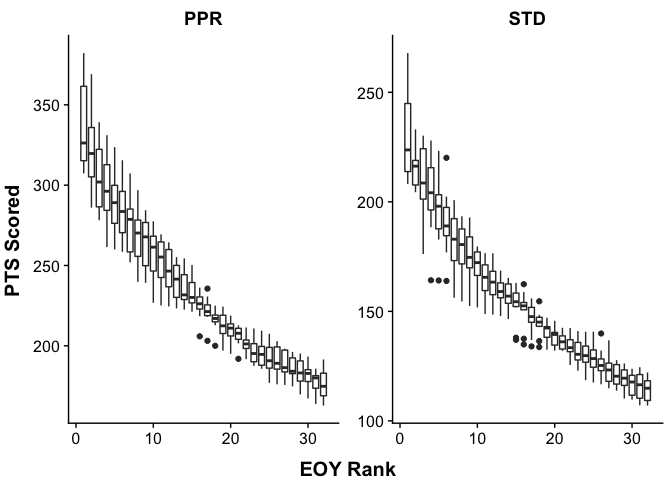 * These
boxplots are just a redrawing of the WR violin plot in the Potential
Wide Receivers Tiers section. The top wide receiver will have the most
significant possible score relative to the next position because there is no upper bound limit to the points for their rank.
* These
boxplots are just a redrawing of the WR violin plot in the Potential
Wide Receivers Tiers section. The top wide receiver will have the most
significant possible score relative to the next position because there is no upper bound limit to the points for their rank.
Weekly Changes in Points
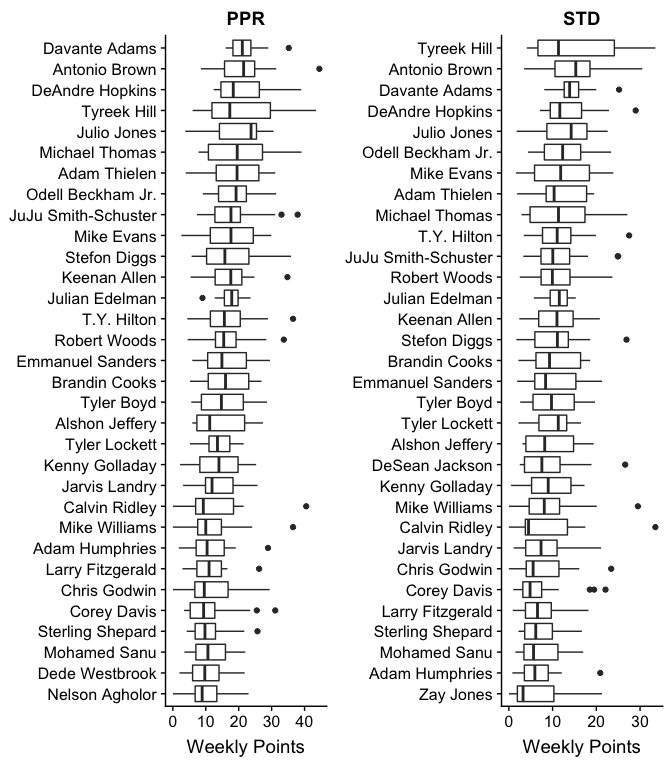
The yearly analysis is fun and matters for the long game, but it’s not super useful when it comes to drafting a team or creating a roster in any given week. I am going to dive right into PPR and STD analysis.
Points Per Reception Analysis
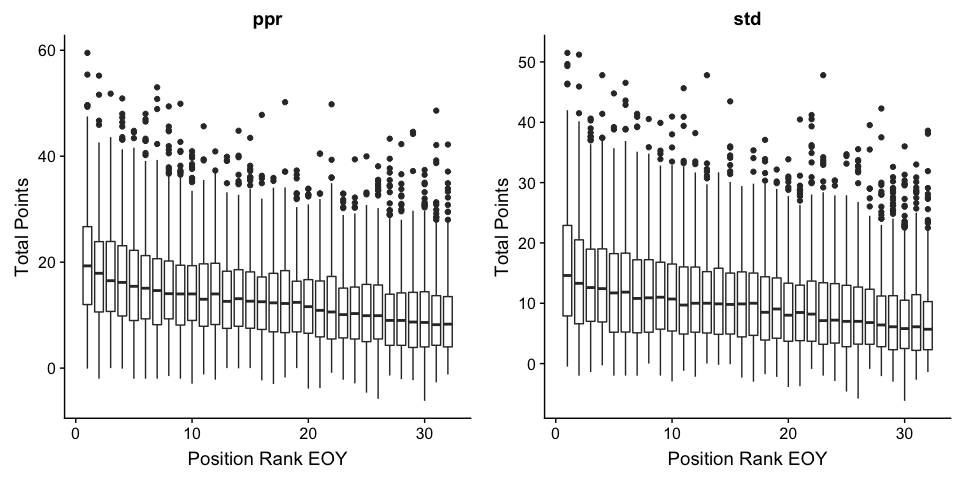
In the graph above, I immediately notice the median points scored (middle line in each box) has pretty large degradation through the first 4-5ish ranks. The most significant cause of the separation by the end of the year is the downside risk associated with their possible weekly scores. This is also present in running backs and I discuss it in a similar section of this post.
Other items of note:
- Almost any WR on any given week can have an outlier score(i.e. in 2018, the first Calvin Ridley break out game where he had 3 TDs and 146 Yards).
- After reviewing the rest of year stats for Ridley, he appeared to be just OK.
If that type of regression to the mean is the most common event after a monster game, selling high could be a great strategy.
The median score for all those WR ranked from 15-20 are so similar, finding a middle round guy with high upside will be my strategy this year.
Standard Scoring Analysis
The most immediate thought in my head after looking at the data is that it would be beneficial to look at the scoring mix for wide receivers to get a feel for the composition of the scores. That has officially been added to my list of analysis for later this summer.
Other things to note:
- It’s incredible how close the median scores are for the Top 15 or so players
- I almost want to punt this position and grab the top RBs
- I’m having a hard time getting over how similar the week to week scoring.
- I’ll probably have to update this post later
Player Analysis in 2018
This post is the first time I’ve ever looked at these two lists side by side. A lot of interesting points. My gut is telling me a player stands on PPR vs. Standard likely has a lot to do with their number of TDs. This post is getting long so I will backlog that analysis for later this summer. I'm also thinking that matchup could be key for explaining wide receiver week-to-week variability. Matchup matters for players at all positions, but maybe it has the largest effect on wide receivers.
Let’s Look Back at Points Per Reception
The curious case of Davante Adams: the consistency he showed last year was terrific. I wish I knew how many teams that won their championship had him on it
If you remove Tyreek Hill’s two games with outlandish points (39,43) and replace them with 19 and 23 point games, he falls to 8th best wide receiver and only 2 points above Mike Evans.
Julio Jones seems to have a low ceiling but high floor. Outside of one game where his score was abnormally low, he is almost a lock to get 10-30 points. His consistency is something to envy.
Standard Scoring’s Turn
Hill’s monster games are even more pronounced in Standard because the average scores for WR are significantly lower than PPR.
Lots of players have very similar scoring ranges from week to week, what ends up separating them is the number of high/low scoring games.
If you can find a guy who is not going to kill you as a WR 2 or WR 3 that could be the key to getting consistent scoring from week to week.
Guys who can make big plays appear to be prime targets in a draft.
- DeSean Jackson is an excellent example of this, his value in PPR is outside top 30 but in Standard, he’s right in that mix.
- He likely won’t be valuable this year because he is on the Eagles
Points Per Reception Conclusion
Everyone has their own draft strategy going into the season. The person in my 14 team league who has won four of the ten years it’s been around swears by going all in on wide receivers and punting everything else.
Let’s answer that question.
After reviewing my RB post, it looks like if you can get the top 2 RB, you will end up better than if you had the top 2 WR. The exciting thing about 2018, the top 4 RB were used heavily in the passing game which drives a lot of their value. If you have a traditional RB (not used heavily in the passing game), you are better off drafting an equivalent WR. WRs also appear to have a higher ceiling on a week to week basis which can be seen in the higher upper range of the boxes which supports the theory of focusing on WRs early in the draft.
Standard Scoring Conclusion
My 14-team league strategy is based on PPR. I am not as versed in the inner working of Standard scoring. I do feel confident in standard formats targeting players that might boom or bust, like DeSean Jackson. I haven't (as of May 10th, 2019) updated the RB post to include standard, which limits my analysis somewhat. From a tiered perspective, grabbing two of the top 15 projected WR seems like the play, given the low variance in median scoring through those positions. The assumption here is the back half of that group will have reasonable average draft positions which allows you to take a better RB or QB where you might experience a more pronounced downgrade in points if you wait longer.