Performance of Top Running Backs
I've always wondered what makes a fantasy player elite within their position group? Outside skill conversations, are there other factors about a player's situation you should take into account when it comes time to draft or pickup? Should you draft players on good teams? With bad defenses? With few alternate weapons on the team? I'm going to attempt to answer these questions in this post.
First in a series
This is the first post in a series on fantasy performance by position--running backs, wide receivers, quarterbacks, and tight ends. My goal is to look at each position independently and then knit together a cohesive drafting and pickup strategy. Check back for updates!
Team Wins
The figure below shows the density of final running back rank against team wins. There is a strong trend of higher running back performance on teams with more wins. This could be the result of good teams having good players or some halo effect players get when they are on a team that wins a lot. Just for the sake of it, let's look at the correlation coefficient between team wins and player fantasy points (correlation != causation so take it with a grain of salt).
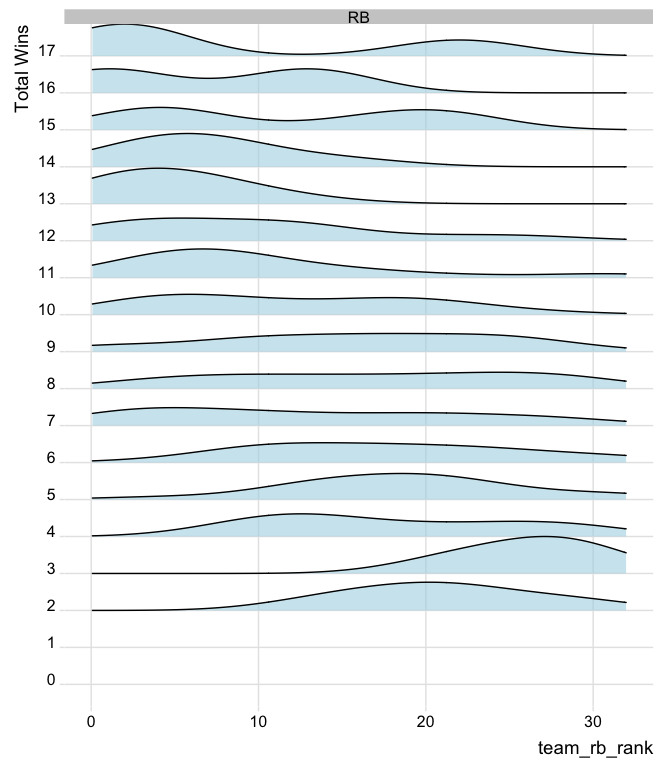
The correlation between total team wins, and fantasy points is 0.15, meaning there is a slight positive correlation. The correlation makes sense--teams that win tend to score more points, suggesting that you should lean towards drafting and picking up players who are on good teams when possible. This is a decent data signal, so I will dig deeper into this in future posts in this series.
<table> <thead> <tr> <th> Correlation Wins vs. Fantasy Points </th> </tr> </thead> <tbody> <tr> <td> 0.15 </td> </tr> </tbody> </table>Running Back Tiers
When I say "tiers," I'm talking about breaking position groups into performance categories--elite, good, average, bad, etc. Tiers are essential to fantasy sports, especially when drafting a team. Tiers will change year-to-year as players cycle through the league and teams alter their offensive/defensive strategies, but they are generally more stable and predictable than individual player performance. The thing that makes tiers useful when drafting is that you can come up with a strategy that doesn't depend on the position individual players are drafted at. You can say, go to your draft with the #6 pick knowing that there are five elite RBs. If one of them makes it to you, you take them. Otherwise, you fall back on a different plan.
All the analysis in this section operates under the assumption that we know who will end the season at each rank. It is a hypothetical exercise if we could go back in time to last season and redo our draft(s).
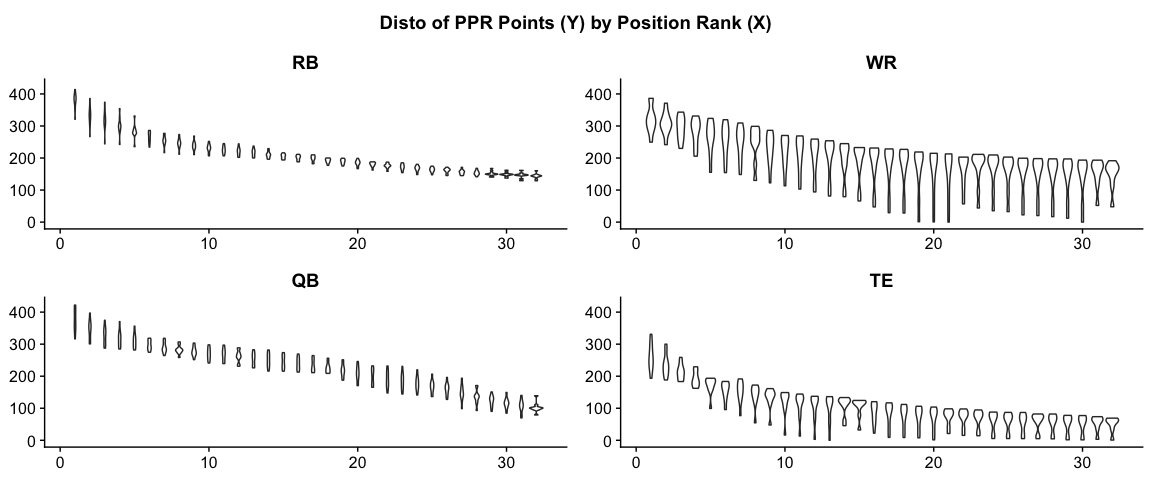
Some positions groups have a lot of elite players; others have drop-offs after just a handful of the best players. The image below shows some interesting patterns for the various position groups. The cool things I see:
- The top 2 running backs are significantly better than the rest. Getting one of these two guys is a top priority if possible given your draft position.
- RB and QB 1-5 are considerably higher scoring than the rest
- After the first two RBs taken, pivoting to WR appears to be the best play if your goal is to maximize points.
- If you don't have the top TE, it's a black hole. What's interesting here, if you can get a top 10 RB or top 20 WR, it probably doesn't make sense to reach the top few TEs, assuming your goal is to maximize your points scored. A top TE gives you an advantage over other players, but it might cost you an edge at WR or RB. Another strategy with TE, grab the top TE because there always seems to be a guy or two off waivers you can pick up at RB or WR that end up being a top talent.
A good follow up analysis will be to look at how often the top players turn over each year. This will be something I attempt to investigate in the next few articles or add to the bottom of this one if I don't get lazy.
Point Fluctuations for Top Running Backs
Let's shift our focus to just running backs and look at how tiers within the running back position group can help us evaluate risk and relative value compared to players in other position groups at a given draft position.
Yearly Data
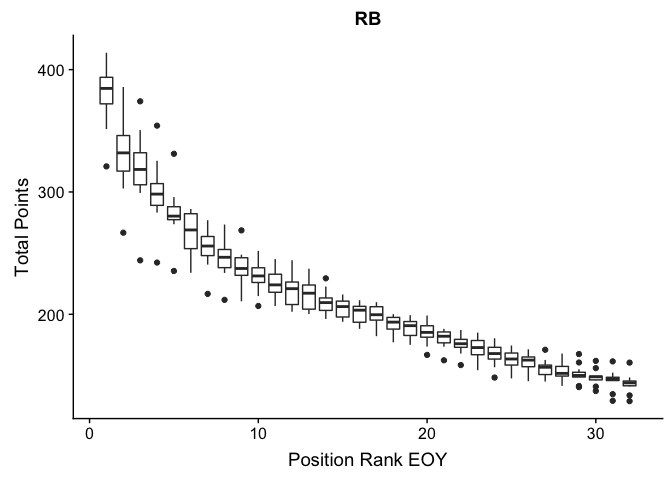
The figure above shows some interesting trends. Fantasy football points for running backs have the highest peak, but they also drop off the quickly. I also see a few tiers that pop out. #1-5 I would say are "elite." #6-13 I would classify as "good." The rest of the players on the graph are probably "average." And anyone outside the top 30 is "bad."
My key takeaway is that when it comes to drafting if I am confident, there is a top ~5 running back available, I will draft them. Probably even over the #1 wide receiver or quarterback.
Weekly Changes in Points
The yearly analysis is fun and matters for the long game. Unfortunately, this isn't baseball where you have 22 weeks of the regular season for players to regress to their mean performance. For fantasy football, we need to look at more granular data.
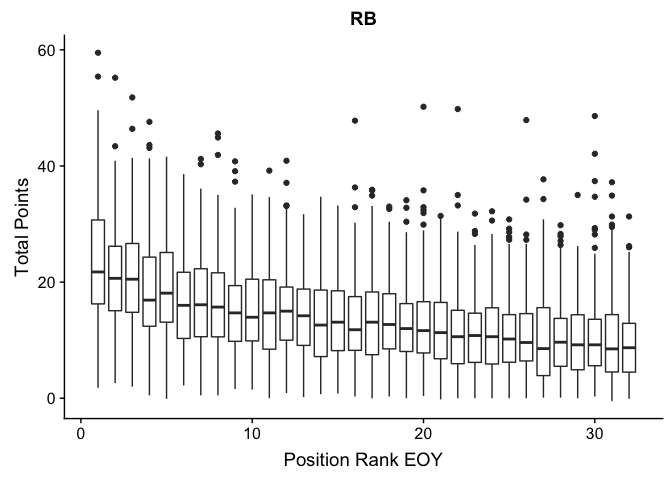
The first thing that I noticed is the ability for any running back to score over 20 points in a given week. I'm not surprised; it's more of a confirmation. The biggest issue as you work your way to lower ranked running backs is the cumulative downside risk. This is reflected in their final position. I want to find a guy who will not kill me each week, though. Generally speaking, the median points scored is not very different from rank 15-32, the gap in the outcome is a function of the weekly variance in points scored.
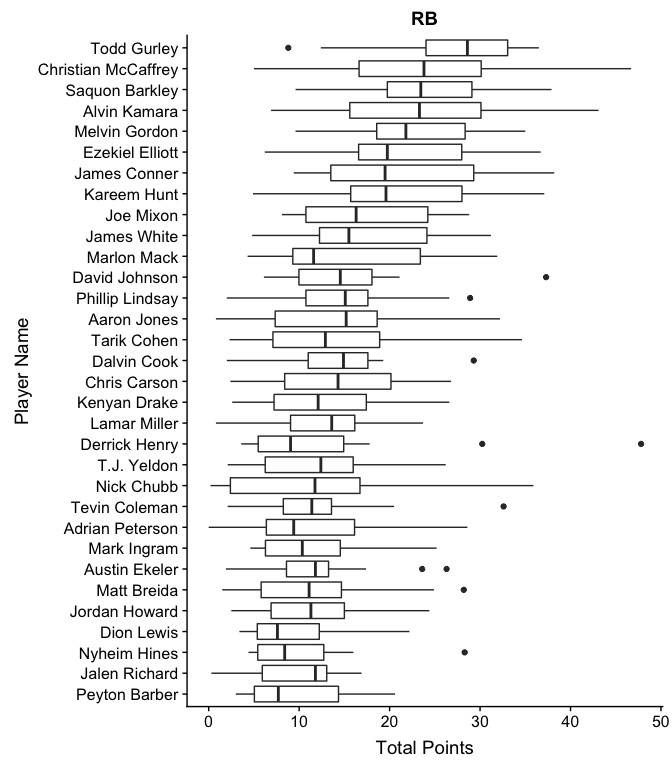
Last year shows some pretty large variances week to week with ~1/3 of all the top 32 players capable of scoring 30 points in a given week. The top 11 all have scores that span the 20 point margin within their IQR (IQR is the difference between the 25th and 75th percentile, meaning half of all values fall between the upper and the lower boundaries of the box. Christian McCaffrey and Alvin Kamara are exciting cases because their IQR is large. It's probably no coincidence they are receiving heavy running backs.
Conclusion
Everyone has their draft strategy going into the season. The person in my 14-team league who has won four of the ten years it's been around swears by going all in on wide receivers early and punting everything else to later rounds. There might be something to that strategy, and hopefully, we can address it in the wide receiver post. Based on looking at running backs, I will focus on drafting a top ~5 running back if possible and cascade my decisions to other positions from there.